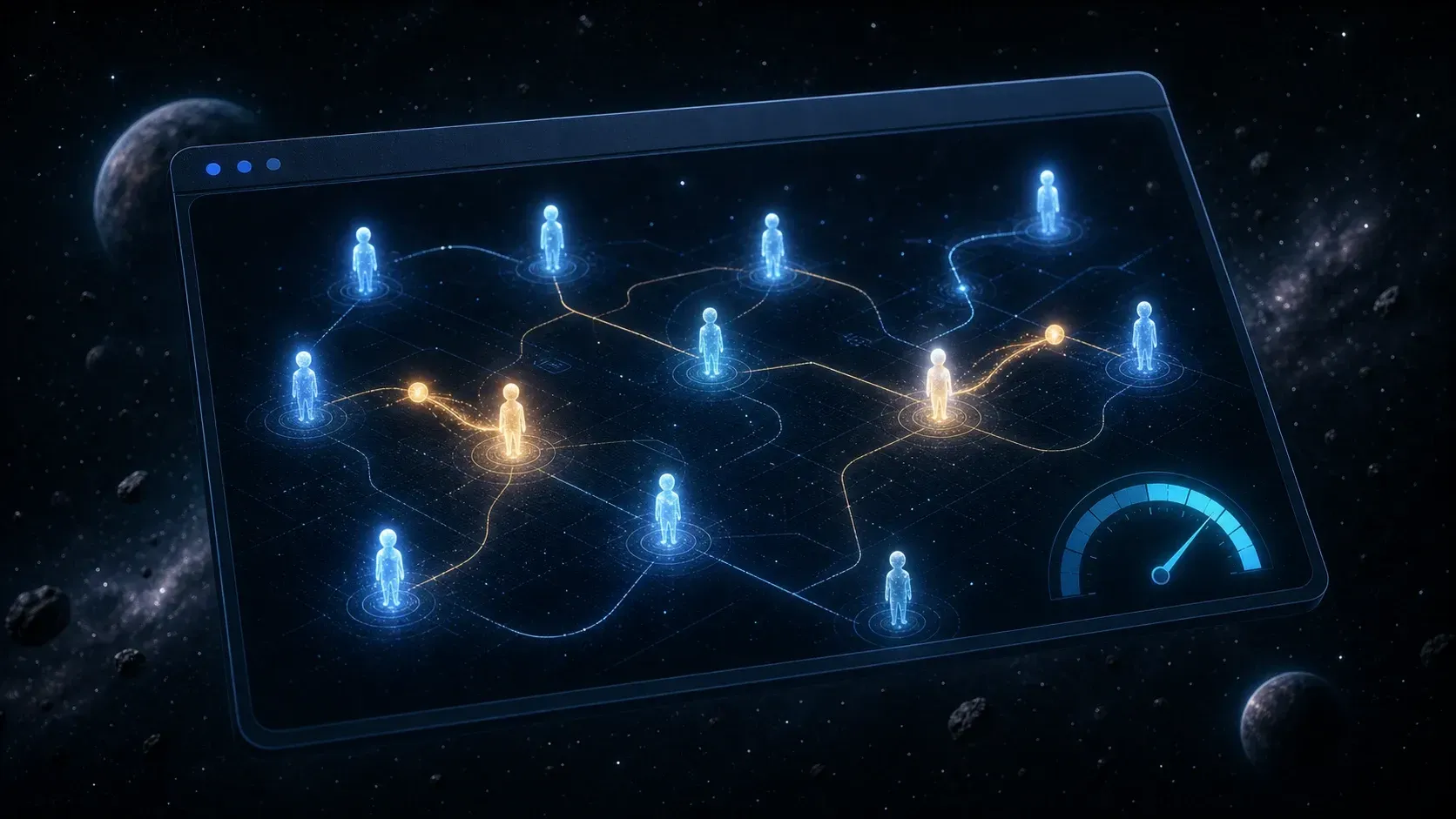
On June 2, 2026, Satya Nadella walked onto a windswept stage at Fort Mason in San Francisco and told 5,000 developers that the era of passive AI assistance is over. "Agents are not just a feature," he said. "They are the new operating system for work."
That's a big claim, and Microsoft spent the next two days backing it up with the largest agent-focused product push the company has ever shipped. Office 365 got persistent multi-agent capabilities. GitHub Copilot graduated from autocomplete to an autonomous coding agent. Azure AI Foundry became an enterprise control tower for agents. And Windows itself was repositioned as an execution environment for AI agents at the operating-system level.
The keynote was loud. The substance underneath it is more interesting than the slogans, and also more demanding. This post is the builder's read: what actually shipped, what's still a preview, where the genuine platform shift is, and what you should do about it before the marketing fades and the invoices arrive.
The Headline Most People Missed
The flashiest announcements were the Office and Copilot agent demos. The structurally most significant one was quieter: Microsoft is formally repositioning Windows as the execution environment for AI agents at the operating system level.
This is not "a desktop that runs AI applications." It's a sandboxed runtime that treats agents as first-class system constructs, with capability grants, lifecycle management, and a distribution channel that looks a lot like the Microsoft Store but for agents. Windows Local AI, a runtime built into Windows 11, lets agents run entirely on-device silicon on qualifying PCs.
If that vision holds, it changes the unit of software distribution. For thirty years the thing you shipped to a Windows user was an application. Microsoft is betting the next thing you ship is an agent: a bounded, permissioned, lifecycle-managed construct that the OS knows how to install, sandbox, and revoke. That's a bigger idea than any single demo from the keynote, and it's the one builder should be thinking hardest about.
The catch, as always, is that a platform designation is a statement of intent, not a finished product. The OS-level agent runtime is early. But the direction is now explicit, and Microsoft has the distribution to make directional bets stick.
What Actually Shipped on Foundry
Azure AI Foundry is where Build 2026 was most concrete, and where builders can act today rather than waiting for a vision to mature.
The throughline was moving agents from prototype to production. Microsoft Agent Framework added stable orchestration building blocks, and the Foundry Toolkit for VS Code reached general availability. Hosted agents in Foundry Agent Service are expected to reach general availability by early July 2026, providing a managed runtime with sandboxed sessions, state, filesystem access, and framework flexibility. The pitch is that you stop managing containers, registries, identity provisioning, and state persistence, and start managing the agent's actual behavior.
Three things stood out as genuinely useful:
Incoming A2A support (public preview). Developers can now expose any Foundry agent as an Agent-to-Agent endpoint. Other agents discover it through its agent card and invoke it via the open A2A protocol, regardless of framework or cloud. Combined with the MCP support Microsoft already shipped, Foundry is positioning itself as a place where agents both consume tools (via MCP) and talk to each other (via A2A). The interoperability story is maturing from slideware into preview endpoints.
A connected observe-evaluate-improve loop. Microsoft's framing is that most teams lose confidence at the operate layer: traces stop at the agent boundary, evaluation is manual, and there's no systematic path from "this agent failed" to "here's a better version." Foundry now routes every model call, tool invocation, sub-agent hops, and handoff through one OpenTelemetry pipeline, with evaluations linking back to the trace. Tracing and evaluation for hosted agents are expected to be generally available later in June 2026.
Agent memory. Memory in Foundry Agent Service (public preview) now includes procedural, user, and session memory, which is the unglamorous plumbing that separates a demo agent from one that's useful across sessions.
The honest read: Foundry is the part of Build 2026 that's closest to production-ready, and the part where the "agents to production" claim is most defensible. If you're building on Azure, this is the actionable layer.
The Governance Primitive Worth Stealing
Buried in the keynote was a feature that deserves more attention than it got: Agent Confidence Scores. It's an evaluation framework that assigns a percentage reliability rating to each agent's output based on historical accuracy. Agents falling below a 95 percent threshold automatically route to a human reviewer before actions execute.
This matters because it's a concrete answer to the question every enterprise asks about agents: how do I keep an autonomous system from doing something expensive and wrong? A confidence gate that auto-escalates below a threshold is a simple, legible governance primitive. You don't need to be on Microsoft's stack to adopt the pattern. Any team shipping agents can implement a confidence-or-escalate gate on high-stakes actions and Build 2026 just made it a mainstream expectation.
The demo that sold it was a healthcare scenario: a triage agent built with Python LangChain coordinating with a HIPAA-compliance checker built on Semantic Kernel, both visible on the Foundry dashboard with real-time latency and token consumption metrics. The multi-framework, multi-vendor composition is the part to notice. Microsoft is no longer pretending you'll build everything in one SDK.
The Cost Conversation Microsoft Would Rather You Have Later
Here's the part the keynote glided past. Build 2026 landed one day after GitHub Copilot moved 4.7 million subscribers to usage-based, token-metered billing. That timing is not a coincidence, and it's the context every cost-conscious builder should hold while evaluating the agent announcements.
Azure-hosted agent runtime, managed through Foundry, is priced on consumption: per-agent invocation and per-tool-call resolved through the Foundry layer. Local execution on Windows is free. The exact per-invocation rates were expected at the keynote, and teams planning high-volume agentic workloads should audit usage carefully before deploying into production.
The pattern across the whole week is consistent: agents are powerful, agents are metered, and the meter runs faster than most teams model. A multi-agent system where a triage agent calls a compliance checker that calls three tools is not one invocation. It's a cascade, and each hop is billable. The observability pipeline Microsoft shipped is genuinely useful here, not just for debugging but for cost attribution. Use it that way from day one.
If there's a single piece of advice that ties Build 2026 together, it's this: treat agent architecture as a cost-architecture decision, not just a capability decision. The teams that win the next year will be the ones who design for invocation efficiency the way previous generations designed for query efficiency.
Where the Creative Layer Fits
One Build 2026 detail points directly at where AI-native creative work is heading. Adobe announced it will rearchitect Photoshop and Premiere for the new NVIDIA RTX Spark platform, with on-device inference capable of running large models locally. Creative software is being rebuilt around the assumption that generation happens inside the tool, on the user's machine, as a native capability rather than a cloud round-trip.
That shift has a parallel in how agents consume creative generation. When a Foundry agent or a Windows on-device agent needs an image, a vector asset, an animation, or a video for the task it's working on, it needs that capability exposed as a callable tool, not as a separate app a human switch to.
This is the bet behind Vanikya. Our MCP server at vanikya.ai/mcp brings image, vector and SVG, Lottie animation, and video generation into agent workflows as native, callable tools. In a world where Foundry agents talk to each other over A2A and consume tools over MCP, creative generation becomes one more capability an agent invokes mid-task: a marketing agent generating a hero image, a documentation agent producing a diagram, a product agent mocking up a UI. The agent-first platform Microsoft is describing needs a creative-capability layer, and that layer is exactly the MCP tool surface we've been building.
What Builders and Founders Should Do on Monday
Six concrete moves, in order of urgency.
One. If you're on Azure, open the Foundry Toolkit in VS Code, create an agent from a template, and run it locally before deploying to Foundry Agent Service. The path from "agent on my laptop" to "agent in production" is the shortest it's been, and the only way to evaluate it is to walk it.
Two. Audit your projected agent costs under consumption pricing before you deploy anything at volume. Model the cascade, not the single call. A multi-agent workflow's cost is the sum of every hop, and that number surprises people.
Three. Adopt a confidence-or-escalate gate on high-stakes agent actions, whether or not you're on Microsoft's stack. Agent Confidence Scores made the pattern mainstream. Implement your own threshold and auto-route below it.
Four. Wire up observability from day one. Foundry's OpenTelemetry pipeline (or your own equivalent) is not a debugging nicety anymore. It's how you attribute cost, catch drift, and build the path from "this failed" to "here's a better version."
Five. Decide your interoperability posture. A2A for agent-to-agent, MCP for tool consumption. If you're building agents that need to be discovered or to discover others, the protocols are now in preview and worth designing around rather than retrofitting later.
Six. If you ship tools or creative capabilities, expose them as MCP servers built for agent traffic. The agent-first platform needs a tool layer, and the tools that are callable, idempotent, and cost-aware will be the ones agents actually use.
The Frame
Microsoft's slogan was "agents are the new operating system for work." Strip away the keynote theater and what's left is a real, specific bet: that the unit of software is shifting from the application to the agent, and that the platform which owns agent distribution, hosting, and governance owns the next decade of enterprise software.
That bet might be right. It's also expensive, early in places, and arriving in the same week the entire industry started metering AI by the token. The opportunity for builders isn't to believe the slogan or dismiss it. It's to act on the parts that shipped, design for the cost reality nobody on stage emphasized, and position your own products as callable, governable, cost-aware pieces of the agent stack that's now forming.
The agents are coming to production. The question is whether your architecture, and your budget, are ready for them.
Insights by Vanikya AI is a publication for builders, founders, and engineers shipping practical AI products. Read more at vanikya.ai.
Vanikya's creative MCP brings image, vector and SVG, Lottie, and video generation into agent workflows as native, callable tools, built for the multi-agent, multi-hop traffic that platforms like Foundry create. Connect at vanikya.ai/mcp.